

You might think any moisture meter will do, but a bad reading can ruin your entire project. That’s why we’ve narrowed it down to two standout models that actually deliver reliable results. The General Tools MMD4E and the Klein Tools ET140 each handle wood moisture differently. So which one belongs in your toolbox? Here’s what sets them apart.
| General Tools MMD4E Moisture Meter for Wood Walls & Water Leak Detection | 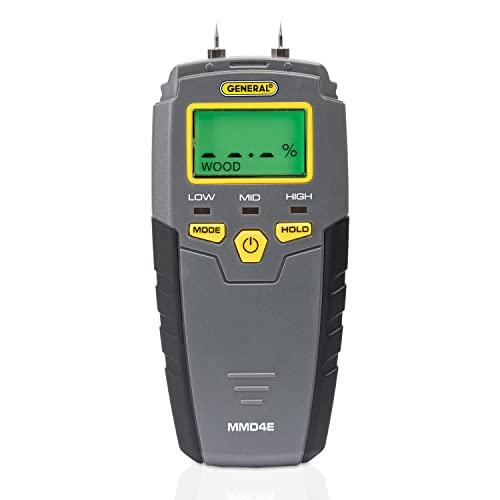 | Best Value | Measurement Method: Pin-type (stainless steel pins inserted into surface) | Materials Tested: Wood, drywall, concrete, subflooring | Display Type: Backlit LCD with 0.3-inch high digits | VIEW LATEST PRICE | Read Our Analysis |
| Klein Tools ET140 Pinless Moisture Meter |  | Professional Grade | Measurement Method: Pinless (electromagnetic field technology, non-destructive) | Materials Tested: Drywall, masonry, hardwood, softwood | Display Type: Bright reverse-contrast display with LED bar graph | VIEW LATEST PRICE | Read Our Analysis |
More Details on Our Top Picks
General Tools MMD4E Moisture Meter for Wood Walls & Water Leak Detection
If you’re tackling home repairs or renovations yourself, the General Tools MMD4E Moisture Meter offers reliable help without breaking the bank. You can quickly detect hidden leaks or dampness behind walls before mold takes hold. Its stainless steel pins, 8mm long, give you precise readings. For wood, you’ll see results from 5% to 50%. For drywall or concrete, it reads from 1.5% to 33%. The backlit LCD shows large, easy-to-read digits. You’ll also get temperature readings within ±2°F. And don’t worry about battery drain; it shuts off automatically. Plus, you get extra pins and a calibration checker right in the box.
- Measurement Method:Pin-type (stainless steel pins inserted into surface)
- Materials Tested:Wood, drywall, concrete, subflooring
- Display Type:Backlit LCD with 0.3-inch high digits
- Power Source:Batteries included
- Auto Power-Off:Yes
- Temperature Measurement:Yes, ±2°F accuracy
- Additional Feature:Pin-type contact readings
- Additional Feature:Calibration checker cap
- Additional Feature:0.6″ penetration depth
Klein Tools ET140 Pinless Moisture Meter
You get professional grade performance without touching the surface. The Klein Tools ET140 Pinless Moisture Meter uses electromagnetic field technology to detect hidden moisture up to 3/4 inch deep in drywall, masonry, hardwood, and softwood. No poking, no damage, just scan and go.
Its bright reverse contrast display pairs with an LED bar graph showing moisture range. You just select your material mode with the mode button, then hold, read, and move on. It even auto powers off to save battery.
- 9V battery included
- 2 meter drop protection
- Weighs just 7 ounces
Klein’s 160 year reputation backs this tool, averaging 4.5 stars from pros. It’s built for daily demands without the fuss.
- Measurement Method:Pinless (electromagnetic field technology, non-destructive)
- Materials Tested:Drywall, masonry, hardwood, softwood
- Display Type:Bright reverse-contrast display with LED bar graph
- Power Source:9V battery included
- Auto Power-Off:Yes
- Temperature Measurement:Yes, ±0.3°C accuracy
- Additional Feature:Pinless EMF technology
- Additional Feature:2-meter drop protection
- Additional Feature:LED bar graph display
Factors to Consider When Choosing a Moisture Meter for Wood
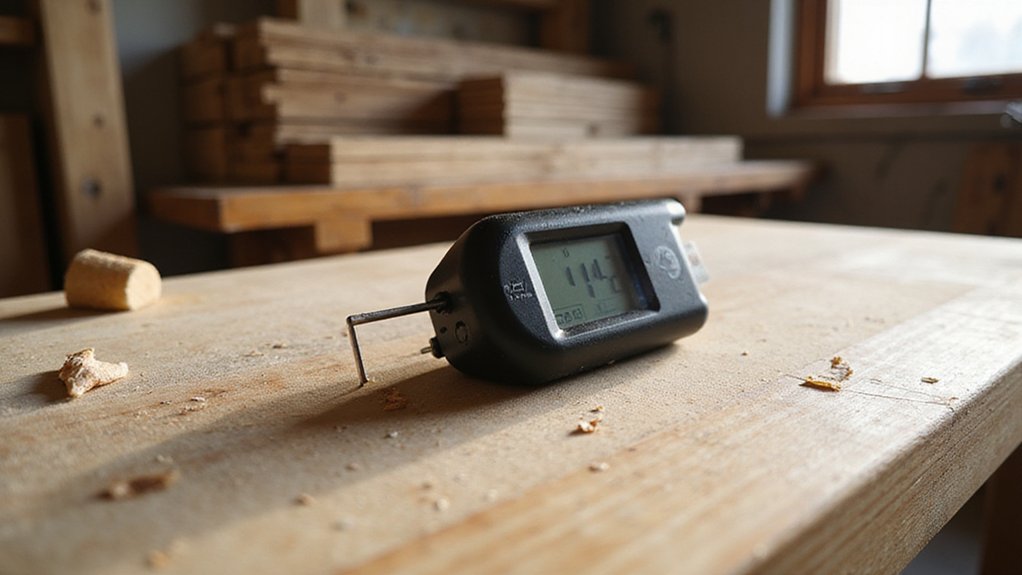
When you’re choosing a moisture meter for wood, you’ll first need to decide between pin type and pinless models. Pin type meters leave tiny holes but offer precise spot readings, while pinless ones scan larger areas without any surface damage. You’ll also want to take into account measurement range accuracy, material type compatibility, depth of detection, and overall ease of use to match your specific woodworking project.
Pin Type vs. Pinless
Since pin-type and pinless meters each shine in different situations, your choice really boils down to what you value more: keeping the surface pristine or pinpointing moisture at a specific depth. Pin-type meters use inserted pins to give you accurate, localized readings, perfect for small or critical areas. You’ll get deeper assessment, but you’ll leave tiny holes. Pinless meters, on the other hand, use electromagnetic fields. They don’t damage finished surfaces, so they’re ideal for drywall or veneered wood. You scan quickly across larger areas, though you’re limited to measuring about ¾ inch (19 mm) below the surface.
So, here’s the simple breakdown:
- Choose pin-type when you need precise depth or spot checks.
- Choose pinless when surface integrity matters or you’re scanning big areas fast.
It’s that straightforward!
Measurement Range Accuracy
Accuracy is the name of the game when you’re hunting down hidden moisture, and the measurement range on your meter sets the stage for what you can actually catch. A wider range lets you detect everything from bone-dry lumber to fully saturated wood, giving you a complete picture. But range alone isn’t enough; you need pinpoint accuracy within that range. Look for a meter with a margin of error of just ±1-2%. That precision means you’ll spot trouble early, not after damage sets in.
Both pinless and pin-type meters offer different range and accuracy levels, so check the specs carefully. A meter that’s out of calibration is worse than no meter at all. And remember, knowing the specific moisture threshold for your material helps you interpret those numbers correctly. For example, wood below 20% is safe for most projects, but you won’t know that without a reliable read.
Material Type Compatibility
Two key factors determine whether a moisture meter will work for your wood projects: material type and sensor compatibility. First, make sure your meter is calibrated for wood specifically, since materials like drywall or concrete require different measurement techniques. Pin type meters are your best bet here, as they insert pins directly into the wood for precise readings. However, if you need non destructive testing across various surfaces, consider a pinless option.
Look for material specific modes or settings too. These adjust the device’s sensitivity based on what you’re measuring, boosting accuracy. And if you work with different wood densities or thicknesses, choose a meter with interchangeable probes or adjustable pins. Confirm its measurement range matches your material’s makeup. For example, a meter built for softwoods won’t give reliable results on dense hardwoods. Get this right, and you’ll avoid frustrating misreads that waste your time.
Depth of Detection
Once you’ve nailed down material compatibility, the next big question is: how deep do you need to see? That depth of detection matters because it tells you where the real problem hides. Pinless meters scan up to 3/4 inch (19 mm) below the surface, perfect for non destructive checks across large areas. They’re great for catching moisture behind drywall or under paint without leaving a mark. But if you need pinpoint accuracy, pin type meters let you insert electrodes to a specific depth, making them ideal for subfloors or dense lumber. And here’s the vital part: seeing deeper means you can stop unseen mold and rot before they wreck your project. Choose shallow detection for quick scans, but go deeper when you suspect trouble’s lurking far below that surface.
Ease of Use
So, what actually makes a moisture meter easy to use? First, you need a display that’s clear and readable, preferably with a backlit LCD or LED indicators. That way, you can grab your readings even in dim workshop lighting without squinting. Next, look for simple controls: one touch operation or easy mode selection minimizes your chance of error and speeds things up.
You’ll also appreciate an ergonomic, lightweight design that lets you work single handedly, especially in tight spots or on long projects. Accurate, consistent measurements come from straightforward pin or pinless sensors, so you won’t wrestle with complex calibration. And don’t overlook extras like automatic shut off or clearly labeled modes; they cut out the guesswork and keep your workflow frustration free.
Durability and Build
For durability, you need a moisture meter that’s built to take a beating. Look for high quality materials like stainless steel pins and robust plastic housing, so it shrugs off frequent use and tough job sites. A well designed model packs protective features such as rubberized grips to cushion drops, plus reinforced casings that resist dings and dust. Corrosion resistant sensors and electronics will keep it accurate longer, even in damp conditions. And you’ll appreciate extras like auto power off, which saves battery and wear. Easy calibration and maintenance are key too; a meter you can quickly adjust stays reliable for years. Don’t settle for flimsy construction. Your investment in a rugged build pays off with consistent, trustworthy readings every time.
Display Readability
What good is a rugged moisture meter if you can’t actually read the display? You need a clear, backlit LCD screen. It boosts visibility in dim workshops or bright sunlight. Large, high-contrast digits let you quickly interpret moisture levels without squinting. Font clarity matters, especially when you’re monitoring small percentage changes. An intuitive layout prevents misreading, so you don’t have to double-check your work repeatedly.
Look for these key features:
- Backlighting: Essential for low-light conditions.
- Digit size: At least 0.5 inches tall for easy reading.
- High contrast: Black text on a white background reduces eye strain.
And remember, readability should hold up across different temperatures; you don’t want a display that fades in the cold. When you can trust what you see, you’ll finish projects faster and with fewer mistakes.
Temperature Compensation
One factor that can really throw off your moisture readings is temperature. If you’re working in a chilly garage or a hot sunlit deck, the ambient temperature can skew your results considerably. Without proper temperature compensation, your meter might tell you the wood is wet when it’s actually dry, or vice versa. That’s a fast track to false assessments and ruined projects.
Most quality meters include automatic temperature correction, using built-in sensors to adjust readings based on the surface or air temperature. This guarantees accuracy regardless of the environment. When you’re choosing a model, look for one that features compensation algorithms or a dedicated temperature sensor. Your measurement range and precision depend on it. Get this right, and you’ll avoid costly mistakes before you even start cutting!